3V0-21.25 Valid Test Test | 3V0-21.25 Valid Braindumps Ebook
Wiki Article
DOWNLOAD the newest TestBraindump 3V0-21.25 PDF dumps from Cloud Storage for free: https://drive.google.com/open?id=16pks_vEdr5c4iw8aHcFbydBpu6yEvndl
Our 3V0-21.25 study questions will update frequently to guarantee that you can get enough test banks and follow the trend in the theory and the practice. That is to say, our 3V0-21.25 training materials boost many advantages and to gain a better understanding of our 3V0-21.25 Guide Torrent. It is very worthy for you to buy our 3V0-21.25 practice guide and please trust us. If you still can't fully believe us, please read the introduction of the features and the functions of our 3V0-21.25 learning questions.
VMware 3V0-21.25 Exam Syllabus Topics:
| Topic | Details |
|---|---|
| Topic 1 |
|
| Topic 2 |
|
| Topic 3 |
|
| Topic 4 |
|
| Topic 5 |
|
>> 3V0-21.25 Valid Test Test <<
3V0-21.25 Valid Braindumps Ebook & 3V0-21.25 Exam Braindumps
As the saying goes, to sensible men, every day is a day of reckoning. Time is very important to people. People often complain that they are wasting their time on study and work. They do not have time to look at the outside world. Now, 3V0-21.25 exam guide gives you this opportunity. 3V0-21.25 test prep helps you save time by improving your learning efficiency. They can provide remote online help whenever you need. And after-sales service staff will help you to solve all the questions arising after you purchase 3V0-21.25 learning question, any time you have any questions you can send an e-mail to consult them. All the help provided by 3V0-21.25 test prep is free. It is our happiest thing to solve the problem for you. Please feel free to contact us if you have any problems.
VMware Advanced VMware Cloud Foundation 9.0 Automation Sample Questions (Q14-Q19):
NEW QUESTION # 14
An administrator is responsible for managing a VMware Cloud Foundation (VCF) fleet and the administrator has been tasked with the following:
* Create DNS records before each virtual machine (VM) is deployed using VCF Automation.
The administrator has already completed the following tasks:
* Created two VCF Operations Orchestrator Workflows with corresponding Event Subscriptions:
* Create DNS Record
* Delete DNS Record
* Created a new blueprint to deploy a VM:
* Added two string inputs, hostname and domainName
* Added hostname: '${input.hostname}' as a custom property of the Virtual Machine resource.
* Added domainName: '${input.domainName}' as a custom property of the Virtual Machine resource.
What should the administrator configure within the Event subscription to ensure that the DNS record is only created when the hostname is provided?
- A. Add the event.data.customproperties['domainName'] != null condition to the Create DNS Record and Delete DNS Record subscriptions.
- B. Enable the Block execution of events in topic option in the Create DNS Record and Delete DNS Record subscriptions.
- C. Add the Delete DNS Record workflow as the Recovery Workflow of the Create DNS Record subscription.
- D. Add the event.data.customproperties['hostname'] != null condition to the Create DNS Record and Delete DNS Record subscriptions.
Answer: D
Explanation:
VCF Automation 9.0 utilizes an Event Broker Service (EBS) to trigger extensibility workflows during the lifecycle of a deployment. For a DNS integration to function correctly and reliably, the event subscription must be "scoped" to prevent it from firing when essential metadata is missing. In this scenario, the administrator has mapped the user input hostname to a custom property of the virtual machine. By adding the condition event.data.customproperties['hostname'] != null to the subscription, the platform evaluates the payload before invoking the Operations Orchestrator workflow. If the consumer leaves the hostname field empty (assuming it is not marked as mandatory in the blueprint), the condition will evaluate to false, and the DNS creation workflow will not be triggered, preventing "empty" or invalid records from being sent to the DNS provider. This logic must be applied to both the creation and deletion subscriptions to maintain parity throughout the VM's lifecycle. Using the customproperties array within the event.data payload is the standard method for referencing blueprint-specific inputs within the VCF 9.0 extensibility framework.
NEW QUESTION # 15
An administrator has been tasked with creating a workflow in VCF Operations orchestrator. The workflow will be used to take a snapshot before planned maintenance work is carried out within the virtual machine, and then automatically remove the snapshot at the end of the maintenance window. The following information has been provided for the workflow:
. The workflow must allow a user to specify a virtual machine on which a snapshot should be taken.
. The workflow must take a snapshot of the virtual machine specified by the user.
. The workflow must name the snapshot based on the current date and time.
. The workflow must delete all snapshots on the virtual machine after a cooling off period of 5 days has elapsed.
. The workflow must stop running after the snapshot is created, a second workflow should automatically start when the 5 day cooling off period has elapsed.
The administrator creates a new workflow for this task and adds an input parameter to allow the user to specify the virtual machine.
Drag and drop the additional five steps the administrator should perform to continue configuring the workflow from the Possible Steps list on the left and place them into the Selected Steps list on the right in any order (Choose five.)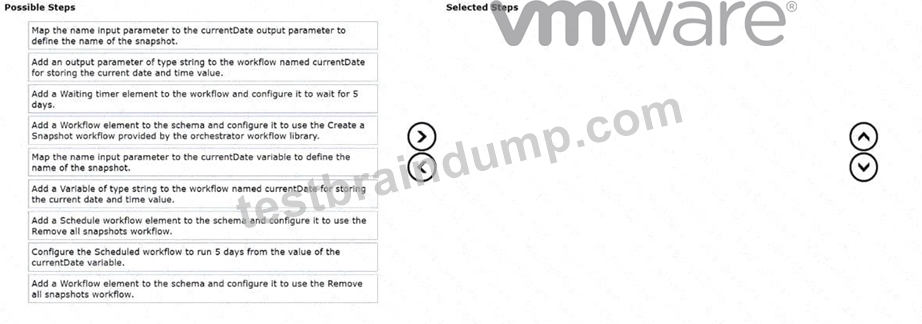
Answer:
Explanation: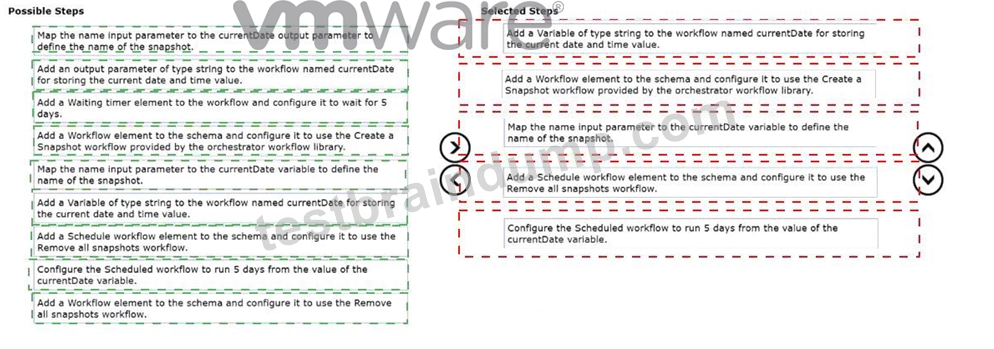
Explanation:
* Add a Variable of type string to the workflow named currentDate for storing the current date and time value.
* Add a Workflow element to the schema and configure it to use the Create a Snapshot workflow provided by the orchestrator workflow library.
* Map the name input parameter to the currentDate variable to define the name of the snapshot.
* Add a Schedule workflow element to the schema and configure it to use the Remove all snapshots workflow.
* Configure the Scheduled workflow to run 5 days from the value of the currentDate variable.
In VMware Cloud Foundation (VCF) 9.0, the Operations orchestrator (vRO) is used to build complex, state-aware automation. To satisfy the requirement that the main workflow stops running while a second cleanup task triggers later, the administrator must use the Schedule workflow element rather than a "Waiting Timer". A waiting timer keeps the workflow "Active," consuming system resources for the duration of the wait (5 days), whereas a scheduled task is handed off to the orchestrator's database to be triggered independently.
The configuration begins by defining a currentDate variable of type string. This variable captures the execution timestamp, which is then mapped to the Create a Snapshot library workflow to provide the required dynamic naming. To handle the automated cleanup, the administrator adds a Schedule workflow element. Unlike a standard workflow call, the scheduler allows for a specific execution offset.
By configuring the Remove all snapshots workflow to run 5 days from the currentDate value, the administrator ensures the snapshot exists for exactly the maintenance and cooling-off period before being programmatically removed. This approach is robust against orchestrator service restarts and provides a clean, asynchronous method for managing the temporary infrastructure lifecycle in a VCF
9.0 environment.
NEW QUESTION # 16
A VMware Cloud Foundation (VCF) Automation administrator is creating a new organization for the Product Development team. The developers require self-service networking that allows them to:
* Provision workloads with virtual machines (VMs) and Kubernetes services.
* Attach these workloads to VPCs.
* Customize how ingress and egress traffic is handled.
Which configuration meets the requirement?
- A. Create an AllApps Organization and assign multiple vSphere-backed networks for consumers to select as needed.
- B. Create a VMApps Organization and assign multiple vSphere-backed networks for consumers to select as needed.
- C. Create a VMApps Organization and use the default VPC with VPC connectivity profiles.
- D. Create an AllApps Organization and use the default VPC with VPC connectivity profiles.
Answer: D
Explanation:
To meet the requirement for self-service networking that supports both VMs and Kubernetes (K8s) within a VPC framework, the administrator must deploy an AllApps Organization. In VCF 9.0, the VMApps model is restricted to traditional vSphere-backed networking and does not support the native VPC construct required by the team. By choosing AllApps, the administrator can utilize the Default VPC provided during the Region- to-Organization mapping. This VPC is governed by VPC Connectivity Profiles, which allow the administrator to define how the organization handles traffic-for instance, allowing the development team to manage their own SNAT/DNAT rules and load balancers for ingress control while maintaining the security guardrails set by the provider. This specific combination of the AllApps Organization type and VPC-centric networking is the only way to provide the requested level of flexibility for "modern" developers who need to manage their own application networking stack alongside their containerized and virtualized services.
NEW QUESTION # 17
A vSphere administrator has created a new vSphere storage policy, labeled Gold Tier, mapped to some new NVMe-backed datastores.
The VMware Cloud Foundation (VCF) Automation administrator is tasked to permit access to this new storage type for consumers of a PerformanceTest Project in an AIIApps organization named Engineering.
What must be done within VCFA to accomplish the task?
- A. Add the Storage Class backed by the Gold Tier storage policy to a Supervisor Namespace Class and bind that Namespace Class to the PerformanceTest Project.
- B. Create a new Zone in VCF Automation, select the Gold Tier vSphere storage policy, and assign the Zone to the PerformanceTest Project.
- C. Configure a Day-2 policy on the PerformanceTest project to enforce Gold Tier as the preferred storage.
- D. Create a new VMApps Organization for Engineering and ensure the Gold Tier vSphere storage policy is selected for new projects.
Answer: A
Explanation:
In an AllApps (AIIApps) organization, resource entitlement follows the Supervisor-native path. To provide access to the "Gold Tier" storage, the VCF Automation administrator must first ensure the vSphere storage policy is recognized as a Storage Class by the Supervisor. The correct operational step is to Add the Storage Class backed by the Gold Tier policy to a Supervisor Namespace Class. The Namespace Class acts as the policy engine that governs what resources are "allow-listed" for the tenant. Once the Namespace Class is configured with the Gold Tier storage class, the administrator must bind that Namespace Class to the PerformanceTest Project. This makes the high-performance NVMe storage visible and available for use by the users within that specific project, allowing them to select it when deploying stateful applications or persistent volumes, without affecting other projects or organizations.
NEW QUESTION # 18
Which three types of profiles do Virtual Private Clouds (VPCs) in VMware Cloud Foundation (VCF) leverage? (Choose three.)
- A. vGPU Profile
- B. QoS Profile
- C. Service Profile
- D. Connectivity Profile
- E. Security Profile
Answer: C,D,E
Explanation:
In VMware Cloud Foundation 9.0, the Virtual Private Cloud (VPC) model utilizes a profile-based approach to standardize and automate network and security services for tenants. The Connectivity Profile is the primary construct used to define the "boundary" of the VPC, determining how the VPC connects to the regional Transit Gateway and whether it has access to external networks or remains isolated. The Security Profile allows administrators to define baseline security postures, such as distributed firewall (DFW) rules and group memberships, that are automatically applied to workloads within the VPC. Finally, the Service Profile is used to enable and configure additional network services, such as Load Balancing or NAT, within the VPC environment. By using these three profile types, the VCF Automation engine can provision consistent, "secure-by-default" network spaces for different organizations or projects, significantly reducing the manual configuration required compared to traditional NSX-T segment management.
NEW QUESTION # 19
......
All contents of 3V0-21.25 training guide are being explicit to make you have explicit understanding of this exam. Their contribution is praised for their purview is unlimited. None cryptic contents in 3V0-21.25 learning materials you may encounter. And our 3V0-21.25 Exam Questions are easy to understand and they are popular to be sold to all over the world. Just look at the comments on the website, then you will know that we have a lot of loyal customers.
3V0-21.25 Valid Braindumps Ebook: https://www.testbraindump.com/3V0-21.25-exam-prep.html
- 3V0-21.25 Pass-Sure materials - 3V0-21.25 Quiz Torrent - 3V0-21.25 Passing Rate ???? The page for free download of ⏩ 3V0-21.25 ⏪ on ⏩ www.examcollectionpass.com ⏪ will open immediately ????3V0-21.25 Exam Duration
- Exam 3V0-21.25 Actual Tests ???? Simulations 3V0-21.25 Pdf ???? Valid 3V0-21.25 Exam Answers ???? Easily obtain ➽ 3V0-21.25 ???? for free download through ➤ www.pdfvce.com ⮘ ????Exam 3V0-21.25 Learning
- Pass Guaranteed Quiz VMware - 3V0-21.25 - Newest Advanced VMware Cloud Foundation 9.0 Automation Valid Test Test ???? Download ▷ 3V0-21.25 ◁ for free by simply searching on ▶ www.dumpsquestion.com ◀ ????Reliable 3V0-21.25 Exam Tips
- 3V0-21.25 Real Exam ???? 3V0-21.25 Valid Exam Bootcamp ???? 3V0-21.25 Exam Registration ↔ Search for ➡ 3V0-21.25 ️⬅️ and download it for free immediately on ➤ www.pdfvce.com ⮘ ????3V0-21.25 Real Exam
- 3V0-21.25 Pass-Sure materials - 3V0-21.25 Quiz Torrent - 3V0-21.25 Passing Rate ???? Go to website ➤ www.prepawayexam.com ⮘ open and search for ➤ 3V0-21.25 ⮘ to download for free ????Exam 3V0-21.25 Learning
- Fully Updated VMware 3V0-21.25 Dumps With Latest 3V0-21.25 Exam Questions [2026] ???? Easily obtain free download of ▶ 3V0-21.25 ◀ by searching on [ www.pdfvce.com ] ????3V0-21.25 Valid Exam Bootcamp
- Quiz 2026 VMware 3V0-21.25: Advanced VMware Cloud Foundation 9.0 Automation Updated Valid Test Test ???? Search for ☀ 3V0-21.25 ️☀️ and obtain a free download on ▶ www.pdfdumps.com ◀ ????Reliable 3V0-21.25 Exam Tips
- 3V0-21.25 Well Prep ???? Valid 3V0-21.25 Exam Answers ???? Real 3V0-21.25 Exams ???? Enter ➤ www.pdfvce.com ⮘ and search for ➤ 3V0-21.25 ⮘ to download for free ????3V0-21.25 Knowledge Points
- Certification 3V0-21.25 Cost ???? Real 3V0-21.25 Exams ???? 3V0-21.25 Reliable Exam Materials ???? Enter ➽ www.prepawaypdf.com ???? and search for ( 3V0-21.25 ) to download for free ????3V0-21.25 Valid Exam Bootcamp
- 3V0-21.25 Pass-Sure materials - 3V0-21.25 Quiz Torrent - 3V0-21.25 Passing Rate ???? Copy URL ▛ www.pdfvce.com ▟ open and search for [ 3V0-21.25 ] to download for free ????3V0-21.25 Real Exam
- Fully Updated VMware 3V0-21.25 Dumps With Latest 3V0-21.25 Exam Questions [2026] ???? Search for ⮆ 3V0-21.25 ⮄ and download exam materials for free through ⮆ www.torrentvce.com ⮄ ????3V0-21.25 Valid Exam Bootcamp
- lorigceg770315.csublogs.com, getsocialpr.com, mariahytjd652668.bloggactivo.com, poppyhgwp641941.blogdeazar.com, maciegweq401738.livebloggs.com, joshadqj568407.wikisona.com, bookmarkmargin.com, rafaelqciv670915.glifeblog.com, sociallawy.com, lululesz030839.blogrelation.com, Disposable vapes
P.S. Free & New 3V0-21.25 dumps are available on Google Drive shared by TestBraindump: https://drive.google.com/open?id=16pks_vEdr5c4iw8aHcFbydBpu6yEvndl
Report this wiki page